
Santo Daime
Santo Daime
The Santo Daime was founded in the Brazilian Amazon state of Acre in the 1930s by Raimundo Irineu Serra, known as Mestre Irineu — a Brazilian of African descent who apprenticed with the indigenous peoples of the Western Amazon and first drank Ayahuasca in the border region between Brazil, Bolivia, and Peru.
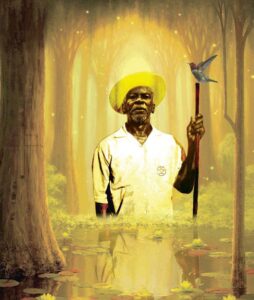 Mestre & Hummingbird ilovesantodaime.net
Origins in the Amazon
Born in Brazil in 1892, Raimundo Irineu Serra migrated to the Western Amazon in 1912, drawn by the rubber-tapping boom. While learning the trade, he also served a spiritual apprenticeship with the Native Peruvians with whom he worked. Ayahuasca has a history of use by tribes of the Amazon for healing and divination dating back thousands of years.
Raised Catholic, Mestre Irineu absorbed many of the beliefs and practices of the Indigenous peoples of the Amazon. His apprenticeship with Ayahuasca included the correct way to prepare it, methods for journeying into ecstatic states, and how to integrate the visions and knowledge brought back from those journeys.
The Queen of the Forest
Mestre Irineu's first significant vision was of the Divine Feminine, appearing in the full Moon — whom he called the Universal Goddess. She instructed him to retreat into the forest for eight days, with only Ayahuasca to drink and boiled manioc to eat.
In the forest he received the instructions for a new faith in which the Ayahuasca was to be called Daime. Dai-me means "give me" in Portuguese, as in "daime força, daime amor" — give me strength, give me love — a phrase found in many of the doctrine's hymns. These directions were given to him by a Spiritual Being he later recognised as the Virgin of the Immaculate Conception, the Queen of the Forest. From these encounters he determined his future and that of those who would follow: the Juramidam people.
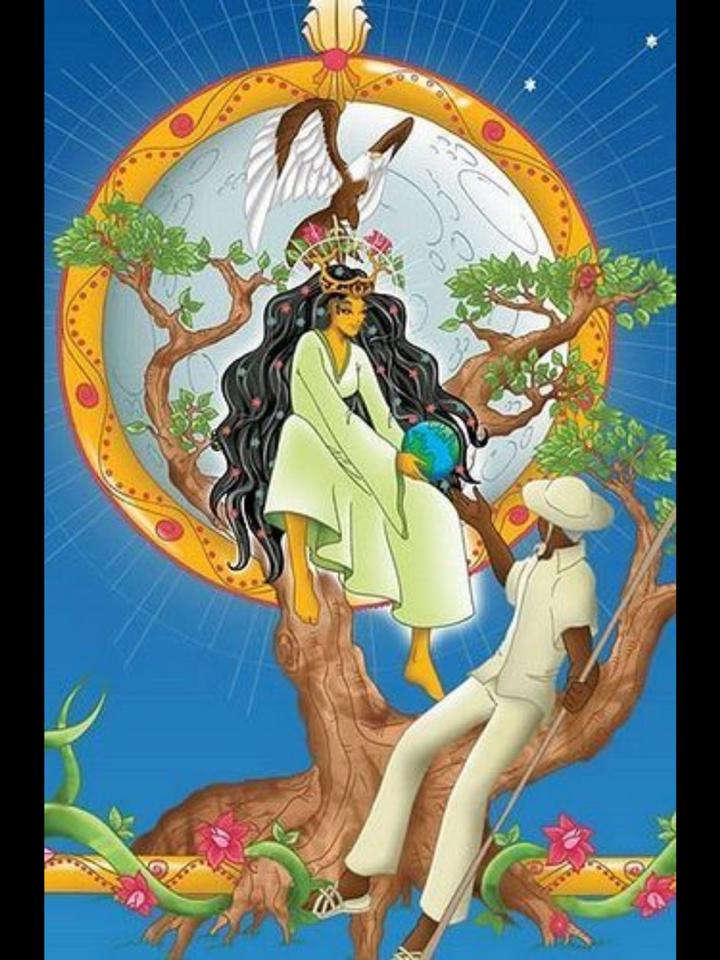 Artwork by César Gyalbo
Mestre Irineu started his new centre in Rio Branco, the capital of Acre, in 1930. He continued to receive visions from the Forest Queen and channelled hymns. Originally, the Santo Daime teachings had no written text — the early practitioners were largely illiterate, the spiritual practice was oral, and learning was experiential through the singing of hymns during the rituals. The hymn collections of the early practitioners have since become the scriptures and guiding principles of the Santo Daime.
Recognition in Brazil
 Himalayan Siddhaa Akshar
Since the 1960s, researchers and authorities have studied the development and expansion of the religious use of Ayahuasca. In 1982 a commission of medical doctors, anthropologists, psychologists, and representatives from the Brazilian Justice Ministry, Federal Police and Army was formed to assess the Santo Daime / Ayahuasca phenomenon. The results were favorable on all levels.
In 1984, through CONFEN — Conselho Federal de Entorpecentes (Brazil's Narcotic Federal Council), a working commission was formed to study the ritualistic use of Ayahuasca. During 1985 and 1986, this group visited many spiritual communities where Ayahuasca was taken as a ritual sacrament, and confirmed the positive findings of former commissions. The commission recommended removing Ayahuasca from the controlled drugs list, and in 1992 the Brazilian government exempted Banisteriopsis caapi, Psychotria viridis, and Ayahuasca from that list.
Mestre Irineu died in 1971, but his work was continued by many of his followers and the Santo Daime spread across Brazil. It became a worldwide movement in the 1990s and now has an international presence.
For a more detailed account of Mestre Irineu's life and a genealogy of the Santo Daime, as well as more information on Ayahuasca, visit www.mestreirineu.org — History of Mestre Irineu and the Santo Daime Doctrine.